
Getting to know SEI: The SEI story more people should know
By Robert Hum, Executive Managing Director, Head of Investment Product & Commercialization

One year in: The SEI story more people should know

A year ago, I wrote about what drew me to SEI: the investment capabilities I discovered while evaluating the opportunity. The response was stronger than I expected and led to countless conversations with advisors, asset managers, and industry peers.
Now, a year into my journey at SEI, I find myself reflecting on a different question.
Not why I joined. But what I've learned.
Recently, I had the opportunity to join Nate Geraci on ETF Prime to discuss the evolution of the ETF market, innovation across the industry, and where we see opportunities ahead. The conversation reinforced something I've experienced repeatedly during my first year at SEI: many people know SEI, but far fewer know the full breadth of what SEI has built over the last three decades.
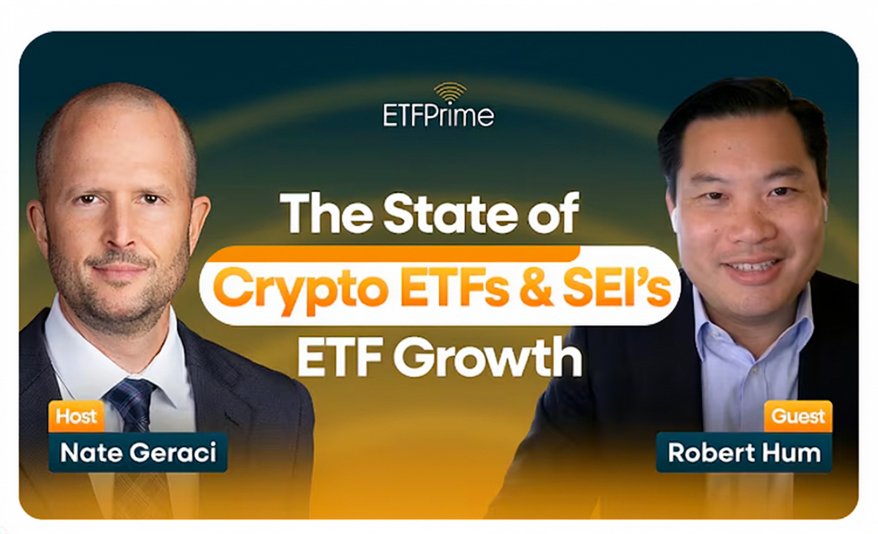
 Watch the episode
Whether the conversation is about quantitative investing, model portfolios, alternatives, or private markets, I often hear some version of the same response:
"I had no idea SEI did that."
What has surprised me most isn't that SEI has these capabilities. It's how consistently they've remained underappreciated despite their scale, history, and impact.
Over the past year, I've come to appreciate that behind many of SEI's most successful businesses are investment capabilities that have been built, tested, and refined across decades. In many cases, they were established long before the broader industry embraced the same ideas.
That's a story worth telling.
Over the next several months, I'll share a series of blogs highlighting three areas that I believe represent some of SEI's most differentiated investment capabilities:
- Our heritage in quantitative and factor investing
- Our scale and leadership in model portfolios and multi-asset solutions
- Our institutional roots in alternatives and private markets
I'll begin with the capability that first caught my attention when exploring SEI: factor investing.
More to come.
Latest insights.



Important Information
Information as of September 30, 2026
SEI Investments Management Corporation (SIMC) is the adviser to the SEI funds, which are distributed by SEI Investments Distribution Co (SIDCO). SIMC and SIDCO are wholly owned subsidiaries of SEI Investments Company (SEI). Quantitative Investment Management (QiM) is a team within SIMC.
SEI has a 38.4% minority ownership interest in LSV Asset Management as of June 30, 2026.
Total platform assets of $138.6 billion, which includes approximately $97.8 billion in assets under management and $40.8 billion in platform-only assets. Platform-only assets represent third-party assets held in custody accounts at SEI Private Trust Company, a federally chartered limited purpose savings association and wholly owned subsidiary of SEI.
The Stratos Family of Companies, has three wholly owned affiliated Registered Investment Advisors: Stratos Wealth Partners, LTD, Stratos Wealth Advisors, LLC, Stratos Investment Management, LLC. A subsidiary of SEI Investment Company is a majority owner of an indirect parent of the three affiliated Stratos Registered Investment Advisors. As of 6/30/26, Stratos Wealth Advisors, LLC manages over $6 billion in advisory assets and over $107 million in third party managed assets. Stratos Wealth Partners, Ltd. Manages over $24 billion in advisory assets and advises through LPL Financial, over $6 billion in brokerage and third-party managed assets.
To determine if the Funds are an appropriate investment for you, carefully consider the investment objectives, risk factors and charges and expenses before investing. This and other information can be found in the Funds’ summary and full prospectuses, which may be obtained by calling 1-800-DIAL-SEI. Read it carefully before investing.
Not FDIC Insured
No Bank Guarantee
May Lose Value
Investing involves risk including possible loss of principal. There is no guarantee investment objectives can be achieved. Funds that trade securities actively could have increased transaction costs (thereby lowering performance) and could increase the amount of taxes you owe by generating short-term gains, which may be taxed at a higher rate.
There can be no assurance that performance will be enhanced or risk will be reduced for investment strategies that seek to provide exposure to certain quantitative factors. Exposure to such investment factors may detract from performance in certain market environments, in some cases for extended periods. In such circumstances, an investment strategy may seek to maintain exposure to the targeted investment factors and not adjust to target different factors, which could result in losses. When factor investment strategies are actively managed, the investment process is expected to be heavily dependent on quantitative models, and the models may not perform as intended.
Passively managed funds are subject to tracking error risk or the risk that the fund’s performance may vary substantially from the performance of the benchmark index it tracks as a result of cash flows, fund expenses, imperfect correlation between the fund's investments and the benchmark and other factors.
Alternative investments are subject to a complete loss of capital and are only appropriate for parties who can bear that risk and the illiquid nature of such investments.
Bonds and bond funds will decrease in value as interest rates rise, High yield bonds involve greater risks of default or downgrade and are more volatile than investment grade securities, due to the speculative nature of their investments.
Both LEND and ANGU may invest in derivatives, which are often more volatile than other investments and may magnify the Funds’ gains or losses. ANGU is not diversified.