
Getting to Know SEI: 30 Years of Factor Heritage
By Robert Hum, Executive Managing Director, Head of Investment Product & Commercialization

Getting to Know SEI: 30 Years of Factor Heritage

In my previous post, I shared a recurring theme from my first year at SEI: many advisors and industry professionals are surprised by the depth and breadth of the firm’s investment capabilities. One area that consistently generates that reaction is factor investing.
What initially attracted me to SEI was discovering that factor investing wasn’t a recent initiative or product launch. It was a capability rooted in decades of research, innovation, and conviction.
Long before factor investing became a common part of advisor conversations and investment portfolios, SEI was backing many of the academic ideas that would eventually become industry consensus.
The story begins more than 30 years ago with a chance meeting that helped shape the future of the firm's investment platform.
A chance meeting that changed everything
In 1994, through what the firm describes as a chance meeting, SEI made one of its most consequential investment decisions: acquiring a significant stake in LSV Asset Management, founded by academics Josef Lakonishok, Andrei Shleifer, and Robert Vishny.
Traditional screening would have eliminated LSV immediately. They had no track record and no assets under management. SEI looked past that and backed the research: a behaviorally grounded quantitative approach to investing that the broader industry would spend decades trying to replicate.
SEI was investing in an idea: that markets are not perfectly efficient, that investor behavior creates persistent and exploitable patterns, and that disciplined, systematic research could identify them. In 1994, that was not consensus. It is now.
That early conviction also informed some of SEI’s earliest factor-aware strategies, including what would become one of the industry’s first minimum and low volatility approaches, built years before that category became widely adopted.
Building the capability internally
SEI’s conviction in systematic investing didn’t stay at arm’s length. It shaped how the firm built its own capabilities.
SEI’s Quantitative Investment Management team, QiM, was developed from the same foundational belief: that factors represent persistent sources of return rooted in investor behavior, and that rigorous portfolio construction is what separates capturing those premia from falling into the traps that catch less careful approaches.
Today, QiM manages more than $30 billion in quantitative strategies across institutional and wealth clients. The intellectual framework has been refined across multiple market cycles, with each strategy built around a specific investment thesis rather than simply targeting a factor label. For example, our approach to momentum reflects the belief that momentum exposure is not a commodity and that portfolio construction decisions matter just as much as factor selection. Read more about our perspective on momentum exposure.
A Pattern of early conviction
SEI’s quant story is not a single moment. It’s a consistent pattern of backing academically grounded ideas before they became industry consensus.
| Era | SEI milestone |
|---|---|
| 1994 | Acquired a significant stake in LSV Asset Management, backing behavioral finance and systematic value investing before it was mainstream |
| Late 1990s | Launched one of the industry's first minimum and low volatility strategies |
| 2000s–2010s | Built and scaled QiM, a $30B+ quantitative platform serving institutional clients across multiple market cycles |
| 2020s | Expanded access to institutional quantitative capabilities through a growing suite of investment solutions, including ETFs |
| 2026 | Partnered with Dr. Andrew Ang and STOXX to develop next-generation index-based core factor solutions. |
Thirty years of conviction
For most of its history, SEI's quantitative capabilities were delivered through institutional mandates, OCIO relationships, multi-asset solutions, and mutual funds. The common thread was always the same: a belief in academically grounded research, disciplined portfolio construction, and the long-term value of systematic investing.
What's striking to me is how consistent that philosophy has remained. While markets, products, and investment vehicles have evolved, the underlying investment principles have endured. The firm's commitment to rigorous research, thoughtful implementation, and innovation rooted in evidence has been a defining characteristic for decades.
A year in, I've come to believe the biggest gap between what SEI is and what the market thinks SEI is lies right there. Behind many of the firm's most successful businesses are investment capabilities that have been built, tested, and refined over decades, yet remain surprisingly underappreciated. That's a story worth telling.
This is the first of a three-part series exploring some of SEI's most differentiated investment capabilities. Next, I'll discuss another area that consistently surprises advisors and industry peers alike: SEI's model portfolio business and how we became one of the largest model providers in the industry.
More to come.
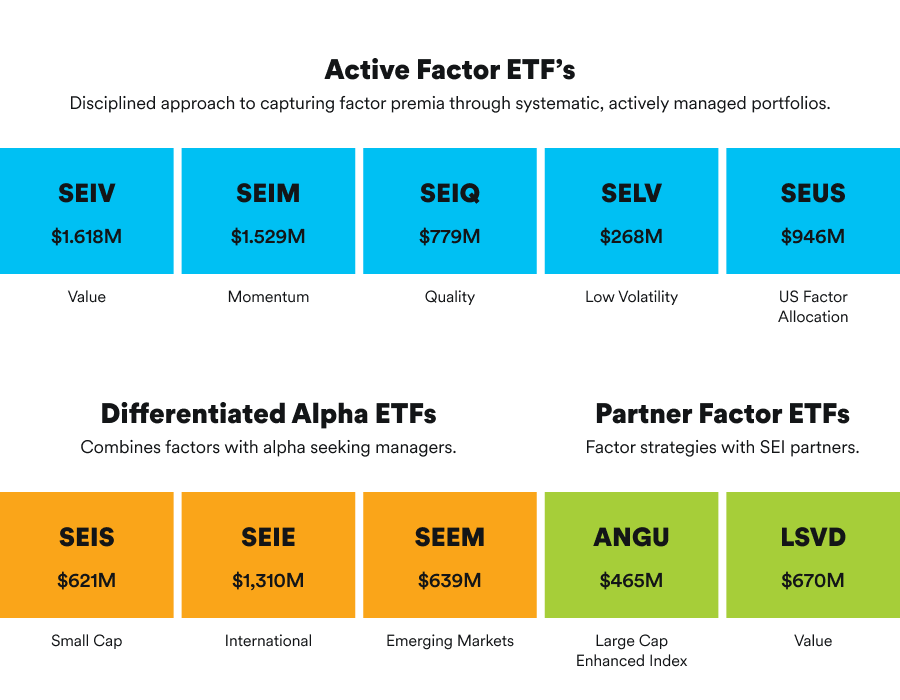
SEI Factor ETF Platform
Thirty years of institutional conviction. Now available to the masses.
Latest insights.



Important Information
Information as of September 30, 2026
SEI Investments Management Corporation (SIMC) is the adviser to the SEI funds, which are distributed by SEI Investments Distribution Co (SIDCO). SIMC and SIDCO are wholly owned subsidiaries of SEI Investments Company (SEI). Quantitative Investment Management (QiM) is a team within SIMC.
SEI has a 38.4% minority ownership interest in LSV Asset Management as of June 30, 2026.
Total platform assets of $138.6 billion, which includes approximately $97.8 billion in assets under management and $40.8 billion in platform-only assets. Platform-only assets represent third-party assets held in custody accounts at SEI Private Trust Company, a federally chartered limited purpose savings association and wholly owned subsidiary of SEI.
The Stratos Family of Companies, has three wholly owned affiliated Registered Investment Advisors: Stratos Wealth Partners, LTD, Stratos Wealth Advisors, LLC, Stratos Investment Management, LLC. A subsidiary of SEI Investment Company is a majority owner of an indirect parent of the three affiliated Stratos Registered Investment Advisors. As of 6/30/26, Stratos Wealth Advisors, LLC manages over $6 billion in advisory assets and over $107 million in third party managed assets. Stratos Wealth Partners, Ltd. Manages over $24 billion in advisory assets and advises through LPL Financial, over $6 billion in brokerage and third-party managed assets.
To determine if the Funds are an appropriate investment for you, carefully consider the investment objectives, risk factors and charges and expenses before investing. This and other information can be found in the Funds’ summary and full prospectuses, which may be obtained by calling 1-800-DIAL-SEI. Read it carefully before investing.
Not FDIC Insured
No Bank Guarantee
May Lose Value
Investing involves risk including possible loss of principal. There is no guarantee investment objectives can be achieved. Funds that trade securities actively could have increased transaction costs (thereby lowering performance) and could increase the amount of taxes you owe by generating short-term gains, which may be taxed at a higher rate.
There can be no assurance that performance will be enhanced or risk will be reduced for investment strategies that seek to provide exposure to certain quantitative factors. Exposure to such investment factors may detract from performance in certain market environments, in some cases for extended periods. In such circumstances, an investment strategy may seek to maintain exposure to the targeted investment factors and not adjust to target different factors, which could result in losses. When factor investment strategies are actively managed, the investment process is expected to be heavily dependent on quantitative models, and the models may not perform as intended.
Passively managed funds are subject to tracking error risk or the risk that the fund’s performance may vary substantially from the performance of the benchmark index it tracks as a result of cash flows, fund expenses, imperfect correlation between the fund's investments and the benchmark and other factors.
Alternative investments are subject to a complete loss of capital and are only appropriate for parties who can bear that risk and the illiquid nature of such investments.
Bonds and bond funds will decrease in value as interest rates rise, High yield bonds involve greater risks of default or downgrade and are more volatile than investment grade securities, due to the speculative nature of their investments.
Both LEND and ANGU may invest in derivatives, which are often more volatile than other investments and may magnify the Funds’ gains or losses. ANGU is not diversified.