
Sustainable investing.
We seek the thoughtful integration of sustainability in our investment practices.
Our key considerations when we rate our managers and their role in upholding sustainable investing standards.

ESG’s role in manager research
In many products, SEI operates as a manager of managers. We build investment strategies by hiring and monitoring specialist investment managers known for their expertise in specific markets or with specific investment styles. We do not take a prescriptive approach to integrating sustainability into our investment process. We believe it is important to include an assessment of a manager’s sustainability practices in our analysis, but that is one factor among several that form the basis for our overall assessment of a manager’s skills and competitive advantages.
First, we evaluate each investment firm’s approach to sustainability. We consider the underlying investment decisions they make and how those decisions tie in with the overall investment philosophy of the organization. Our ranking system considers three broad sets of factors:
Then, we evaluate each investment strategy that we consider for our portfolios. We look at active and passive strategies a little bit differently but ultimately are seeking to understand how sustainability is factored into the investment decisions or index construction, as well as how the strategy carries out stewardship activities.
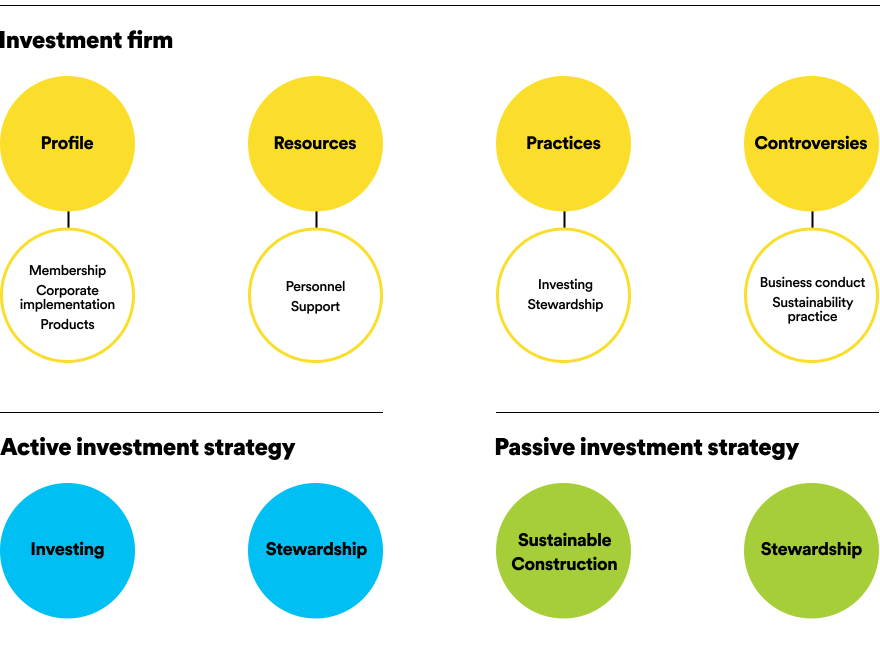
We created a proprietary ranking system to rate the managers we hire for our investment offerings.
Every firm and strategy that is considered undergoes a due diligence review and receives a score of Strong, Moderate, Limited or Weak. We have not established a minimum threshold to hire a firm or select a strategy, with an exception for in funds classified under SFDR Article 8 or that carry an explicit sustainability mandate. These firms and strategies must meet our minimum expectations.
Qualitative assessment plays a significant role in our ESG scores. We don’t rely much, if at all, on third-party analytics. Instead, we rely on qualitative assessment of manager commitment and action. This leads to detailed discussions with managers to assess how they put sustainable investing into action in both their investment and stewardship processes. Manager transparency is therefore critical. Like any qualitative analysis, it is judgmental. To minimize biases, we have created criteria to define our qualitative assessment in order to support the overall evaluation.
Quantitative issues are a well-known challenge in the industry due to data availability and consistency. Until those improve, we are inclined to place greater emphasis on our qualitative judgments.
We have created a framework to codify our best thinking on what we deem to be most relevant and important to evaluating a firm or manager’s sustainable investment practices. While the final analyst rating avails itself of this structured analysis, discretion on a final score is left to the analyst to weigh those factors with greatest significance in their judgment.
Firm scores are re-assessed on a biennial basis and strategy scores are re-assessed annually.
Despite its popularity and an increase in regulations, there are still no clearly defined standards guiding sustainable investing.
We think that sustainable investing may be more widely considered an inherent component of fundamental analysis in the future. As the industry settles on a common definition of sustainable investing and simplifies regulation around reporting and materiality, this type of analysis may become more straightforward.
We seek the thoughtful integration of sustainability in our investment practices.
We’re deeply committed to helping our institutional clients achieve their sustainability goals.
SEI Stewardship Code 2024
Discover how SEI Investments (Europe) Ltd drives responsible and sustainable investment in the UK financial sector. Download the 2024 UK Stewardship Code report to learn more.

Important Information
Discover how SEI Investments (Europe) Ltd drives responsible and sustainable investment in the UK financial sector.
Our TCFD report is available for review.
Information presented is intended to be educational and should not be construed as investment advice. Carefully consider the investment objectives, risk factors and changes and expenses before investing.
Sustainability guidelines may cause a manager to make or avoid certain investment decisions when it may be disadvantageous to do so. This means that these investments may underperform other similar investments that do not consider sustainability guidelines when making investment decisions. There can be no assurance goals will be met. If a product or strategy is subject to certain sustainable investment criteria it may avoid purchasing certain securities when it is otherwise economically advantageous to purchase those securities, or may sell certain securities when it is otherwise economically advantageous to hold those securities. Sustainability is not uniformly defined and scores and ratings may vary across providers. Investments in the U.S. are provided by SEI Investments Management Corporation, a registered investment advisor and wholly owned subsidiary of SEI Investments Company. Investments in the U.K. provided by SEI Investments (Europe) Ltd (SIEL) 1st Floor, Alphabeta, 14-18 Finsbury Square, London EC2A 1BR. SIEL is authorised and regulated by the Financial Conduct Authority.